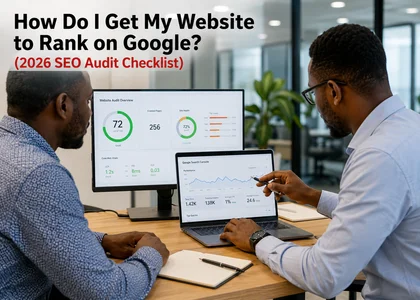
How Do I Get My Website to Rank on Google? The Complete Website SEO Audit Checklist (2026)
Many business owners invest thousands of cedis into building a website, expecting customers to automatically find them on Google. Unfortunately, that is rarely how search engines work.
At the Global Institute of Entrepreneurship and Technology (GIET), we’ve worked with businesses that launched beautiful websites but received little to no organic traffic. In many cases, the problem wasn’t the design. The real issue was a combination of technical SEO errors, weak content strategies, poor keyword targeting, lack of authority, and missed optimization opportunities.
If you’ve been asking:
- How do I get my website to rank on Google?
- Why is my website not getting traffic?
- Why do my competitors appear before me?
- What SEO issues are stopping my website from ranking?
This guide will help you diagnose the problem.
Rather than giving you generic SEO advice, this article provides a practical website audit checklist that helps identify the exact issues that may be limiting your visibility in Google search results.
Why Your Website Is Not Ranking on Google
If you’re looking for a deeper explanation of the most common ranking problems, our guide on why websites fail to rank explores those issues in detail.
The GIET Digital Visibility Framework™
Through website development, SEO consulting, and digital marketing projects, GIET has found that websites that rank consistently well usually perform strongly in five key areas:
Phase 1: Discoverability
Can Google find and crawl your website?
Phase 2: Relevance
Does your content match what users are searching for?
Phase 3: Authority
Does Google trust your website?
Phase 4: Performance
Does your website provide a great user experience?
Phase 5: Conversion
Can your website turn visitors into leads and customers?
If any of these areas are weak, your rankings can suffer.
Let’s audit them one by one.
Website SEO Score Card
Before diving into the detailed checklist, answer the following questions.
Give yourself one point for every “Yes.”
| SEO Check | Yes | No |
|---|---|---|
| My website is indexed by Google | □ | □ |
| Google Search Console is installed | □ | □ |
| XML sitemap is submitted | □ | □ |
| My website is mobile-friendly | □ | □ |
| My website loads quickly | □ | □ |
| Every page targets a keyword | □ | □ |
| I publish content regularly | □ | □ |
| My website has internal links | □ | □ |
| I have quality backlinks | □ | □ |
| My Google Business Profile is optimized | □ | □ |
| My content satisfies search intent | □ | □ |
| I track website conversions | □ | □ |
| My website has an SSL certificate | □ | □ |
| I regularly update content | □ | □ |
| I have completed an SEO audit in the last 12 months | □ | □ |
Your Score
0–5 = Critical SEO Issues
6–10 = Moderate SEO Issues
11–15 = Strong Foundation With Room For Growth
Phase 1: Discoverability Audit
The first question is simple:
Can Google actually find your website?
Many websites fail before they even reach the ranking stage.
Check #1: Is Your Website Indexed?
Search:
site:yourdomain.com
If your pages don’t appear, Google may not be indexing your content.
Fix
- Verify ownership in Google Search Console
- Submit your sitemap
- Request indexing
During website audits conducted by GIET, indexing issues remain one of the most common technical problems affecting small business websites.
Check #2: Do You Have an XML Sitemap?
A sitemap helps Google discover important pages faster.
Fix
Create and submit a sitemap through Google Search Console.
Check #3: Are Search Engines Allowed To Crawl Your Website?
Developers sometimes accidentally block search engines.
Check:
- robots.txt
- noindex tags
- crawl restrictions
Check #4: Is Your Website Secure?
Google prefers secure websites.
Fix
Install an SSL certificate and ensure your website uses HTTPS.
Phase 2: Relevance Audit
Even if Google finds your website, it still needs to understand what your content is about.
Check #5: Are You Targeting The Right Keywords?
One of the biggest mistakes businesses make is targeting broad keywords that are extremely competitive.
Instead of: “Website Design”
Target: “Website Design Services in Ghana” or “E-Commerce Website Design for Small Businesses” Long-tail keywords often generate faster results.
Check #6: Does Your Content Match Search Intent?
Google prioritizes pages that satisfy user expectations.
Ask yourself:
When someone searches this keyword, are they looking for:
- Information?
- A service?
- A comparison?
- A solution?
Your content should provide the answer they’re expecting.
Check #7: Does Every Important Page Target A Primary Keyword?
Many websites have service pages that aren’t optimized for any search term.
Every major page should have:
- A primary keyword
- Supporting keywords
- Optimized headings
- Relevant content
Check #8: Is Your Content Better Than The Competition?
Review the top-ranking pages.
Ask:
- Is my content more detailed?
- More useful?
- More current?
- More actionable?
If the answer is no, improvements are needed.
Best Digital Marketing Company in Ghana
Understanding search intent and content strategy is a key part of effective digital marketing.
Phase 3: Authority Audit
Google wants proof that your website deserves trust.
Check #9: Do You Have Quality Backlinks?
Backlinks remain one of Google’s strongest ranking factors.
Focus on earning links from:
- Industry websites
- Business directories
- Professional associations
- Local organizations
Check #10: Do You Demonstrate EEAT?
Google values:
Experience
Have you actually done what you’re talking about?
Expertise
Do you demonstrate knowledge?
Authoritativeness
Are you recognized in your industry?
Trustworthiness
Can visitors trust your content?
At GIET, one of the first recommendations we give businesses is to showcase real expertise through case studies, testimonials, team profiles, and success stories.
Check #11: Do You Have Brand Mentions Online?
Mentions across websites and social platforms help strengthen credibility signals.
Check #12: Are You Building Topical Authority?
Publishing one article is rarely enough.
Google prefers websites that comprehensively cover a topic.
For example, a website focused on digital marketing should publish content around:
- SEO
- Social Media Marketing
- Google Ads
- Website Development
- Content Marketing
- AI Marketing
Best Digital Marketing Course in Ghana
Best Digital Marketing School in Ghana
Phase 4: Performance Audit
User experience directly affects rankings.
Check #13: Is Your Website Fast?
Slow websites frustrate users.
Target:
Less than 3 seconds load time.
Common Causes
- Large images
- Cheap hosting
- Poor optimization
- Excessive plugins
GIET website audits frequently uncover performance issues that can be fixed with relatively simple optimizations.
Check #14: Is Your Website Mobile Friendly?
More than half of web traffic comes from mobile devices.
Your website should:
- Display properly
- Load quickly
- Be easy to navigate
Check #15: Is Your Navigation Clear?
Visitors should find information quickly.
Complex menus often increase bounce rates.
Check #16: Are There Broken Links?
Broken links create poor user experiences and can negatively affect SEO.
Best Web Design Company in Ghana
Many SEO challenges originate from poor website structure and outdated design practices.
Phase 5: Conversion Audit
Getting traffic is only half the battle.
Your website should convert visitors into customers.
Check #17: Do You Have Clear Calls-To-Action?
Examples:
- Request A Quote
- Schedule A Consultation
- Contact Us
- Get Started
Check #18: Do You Track Conversions?
Without measurement, improvement becomes difficult.
Install:
- Google Analytics
- Google Tag Manager
- Conversion Tracking
Check #19: Is Your Website Built For Lead Generation?
Many websites look good but fail to generate inquiries.
Ensure visitors can easily:
- Contact you
- Request services
- Complete forms
- Take action
The Most Common SEO Problems Businesses Face
During website audits and digital marketing consultations, GIET frequently encounters:
- Poor keyword targeting
- Missing metadata
- Thin content
- Weak internal linking
- Duplicate content
- Slow website speed
- Poor mobile performance
- Lack of backlinks
- Technical SEO errors
Addressing these issues often leads to measurable improvements.
When DIY SEO Stops Working
There comes a point when business owners need professional assistance.
If:
- Rankings remain stagnant
- Traffic continues declining
- Competitors consistently outrank you
- Technical SEO feels overwhelming
it may be time to seek expert support.
How GIET Helps Businesses Improve Google Rankings
At GIET, website development is approached differently.
Rather than simply creating attractive websites, the focus is on building websites that are optimized for visibility, performance, and growth.
Services include:
- Website Development
- Search Engine Optimization
- Technical SEO Audits
- Local SEO
- Content Marketing
- Website Optimization
- Digital Marketing Strategy
By integrating SEO considerations from the beginning, businesses can build a stronger foundation for long-term online success.
Conclusion
If you’re wondering how to get your website to rank on Google, the answer is rarely a single fix.
Successful websites perform well across discoverability, relevance, authority, performance, and conversion optimization.
By working through this SEO audit checklist, you can identify hidden issues, prioritize improvements, and create a stronger foundation for search visibility.
Ranking on Google is not about tricks or shortcuts. It’s about consistently providing value, demonstrating expertise, and creating a website that both users and search engines trust.
Businesses that invest in these fundamentals are far more likely to attract organic traffic, generate leads, and achieve sustainable online growth.
FAQs (Frequently Asked Questions)
There is no guaranteed shortcut. The fastest improvements usually come from fixing technical SEO issues, improving content quality, targeting the right keywords, and ensuring your website is properly indexed.
Common causes include indexing problems, poor SEO optimization, lack of authority, weak content, or technical errors.
Yes. Website speed, mobile responsiveness, navigation, and user experience all influence rankings.
At least once every 6–12 months, or whenever major website changes occur.
Yes. GIET provides website development, SEO, technical audits, and digital marketing services designed to help businesses improve search visibility and online performance.